You’re at lunch with some coworkers, and you hear someone mention a conversation happening in Slack that has implications for your work, so you ask them to send you a link to the conversation.
When you get back to your desk, you open Slack, and immediately facepalm.

You now face a dilemma. Do you demand access to this private channel to participate in the conversation, and risk sounding pushy or overstep a team boundary? Or do you ask that someone take valuable time out of their day to summarize the conversation for you, knowing that you will only get a snapshot of the discussion and still won’t be able to participate as the conversation evolves?
Hidden information sources like private channels and direct messages (DMs) are commonly used in collaboration tools like Slack and Teams. They are necessary for safely discussing some subjects, like personnel situations or sensitive topics. However, using them pervasively is an anti-pattern. Organizations work more effectively if information is open and accessible.
Private channels are information vaults
Private channels represent vaults of information; only accessible to the lucky few who have the right permissions. These digital vaults are often worse than the silos found in offices which only use email and in-person meetings: you can easily get added to an email thread, or walk by a meeting room and ask to join in when you spot something important to you being discussed on the whiteboard.
Private channels, however, are sealed tight. You can’t even search for them to find out if they exist.
Common objections to using public channels
Eliminating these vaults requires more than a technical change: doing so requires a cultural shift. Companies with high numbers of private channels can’t just flip a switch and suddenly work out in the open. Build a solid understanding of the reasons for why people gravitate to private channels to uncover the solutions to making them go public. Here are some of the most common objections:
Objection 1: “We feel more comfortable chatting in a private channel”
People who don’t experience psychological safety in their workplace will prefer to keep their work hidden away from others, especially from those who could weaponize their conversations against them.
It is pointless for an organization to expect their teams to work in the open in a chat system if they are already afraid to be open and vulnerable when communicating in person. This kind of cultural illness must be treated first.
That said, it’s important to recognize that private channels and DMs do have their place, and people do need a place to discuss things safely. The solution is to have just those conversations in a private channel. Once any conversation moves back to project work from which others could benefit, it should move to a public channel focused on that project.
Objection 2: “We don’t want people on other teams getting the wrong idea about something we’re working on before it’s ready”
This is a common concern in large organizations that have large, infrequent, structured product release processes. Years of careful internal messaging – ostensibly to reduce ambiguity – can make it less comfortable to work in the open. However, even companies that need to carefully coordinate product announcements can benefit dramatically by working more openly.
The solution is to make it very clear in your public channels which ones are for ongoing work, and which are for official release announcements, and to educate everyone about how to interpret information in both. For example, set the “description” for the channel about in-progress work to clarify that it should not be shared externally. If people still ignore these directives and do the wrong thing with internal information, then you probably have a personnel problem to solve.
Crucially, embrace the fact that people outside of the product team might bring helpful feedback that the developers really need to hear.
Objection 3: “Nobody else needs to read our team conversations”
First, don’t be so sure! People from other parts of the organization can benefit enormously from the information shared in other team discussions. They also might not ever actively participate in the conversations, but they might search through them at a later stage as part of some other project effort.
Second, a wonderful phenomenon teams experience when they move to public channels is the increase in serendipitous events. A software engineer could observe what it’s like to work in product management, or maybe a support rep could spot an issue occurring across multiple parts of the product even though individual teams didn’t notice the pattern.
Objection 4: “We would get overwhelmed by so many public channels”
Left uncoordinated and unmanaged, Slack and Teams become messy, noisy, and confusing. Having experienced this kind of chaos, many people end up believing that these tools cannot scale and are only suitable for small startups.
But with the right effort, these tools can scale just fine. The Rands Leadership Slack currently has 35,000 members, huge daily activity, and many public channels covering a wide range of topics. Its success comes from how its members structure and manage it:
- Clear naming conventions for channels
- Disciplined use of threads for long discussions
- Strong discouragement of “loud” notifications like
@channeland@here - Automatic archiving of stale channels
- An “information booth” channel dedicated to helping members find the right topic channels
- High mobility across channels, with members leaving and joining channels as their interests change
The chance of success of a tool like Teams, Discord, or Slack in a team is directly proportional to the amount of care it gets in terms of organization, curation, and cleanup. Just like real-world libraries index their contents with the Dewey Decimal System, collaboration tools need organization too.
Objection 5: “We are a public company, so we can’t risk sensitive information ending up in public channels for all employees to see”
Plenty of highly regulated or public companies use collaboration tools and communicate openly within them without breaking any rules. For example, HubSpot is a public company with thousands of employees who make any potentially helpful information accessible to all its staff. Even their board presentations and sales forecasts – highly sensitive information! – are visible to all who work there. They also use Slack and are well known for primarily using public channels for their internal communications.
If employees aren’t trusted with internal information, that’s not a problem any tool can solve. Attempting to work around that lack of trust by building stronger vaults only reinforces the problem.
A team is not a topic
A typical “newbie mistake” (and one that makes public channels less favored) is to use mostly team-oriented channels. Marketing gets #team-marketing, sales gets #team-sales, and so on.
Team-based channels are needed for some discussions, but only using team channels is a recipe for frustration. As more diverse projects and topics get discussed on a team channel, the more likely people from other groups will need to join the channel to weigh in. The more people in a channel, the noisier it will be, and the more likely the core team members will create some quieter space in a new private team channel.
While teams are not topics, things like projects, features, deals, and customers certainly are. Scoping your organization’s communications around these kinds of items is far more effective at encouraging healthy cross-department collaboration. Use a simple naming prefix like #proj- for projects or #cust- for customers to build habits around this.
Aside: Microsoft Teams is designed in a way that makes it more likely to have more team-oriented channels (I guess it’s in the name, after all…). If your company uses Teams, you will need extra energy and discipline to resist that structure, and curate topic-based channels instead.
Check your progress
Slack has useful analytics – available to all members – on how many messages are sent or read in public, private, or direct channels.
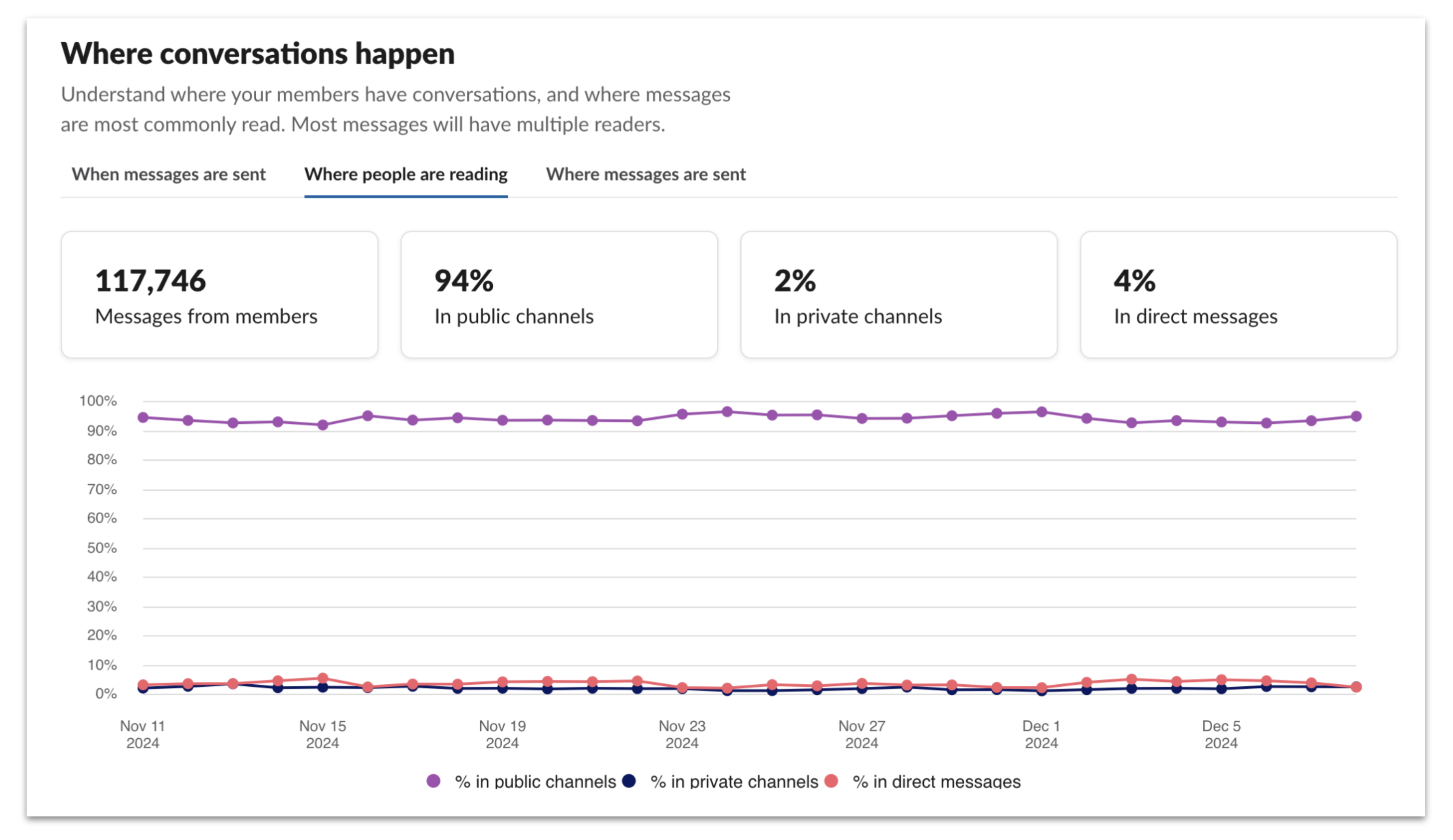
Get a baseline reading on your organization’s public/private ratio and track it over time.
Summary
Tools like Slack and Teams are an essential part of the modern tool set, and we are slowly learning the best ways to use them. Being intentional about their usage is crucial.
To build an openly communicating organization centered around public channels, make sure to:
- Ensure psychological safety and a culture of trust and feedback
- Favor “topic” channels over team channels
- Create basic policies for consistency, notifications, and usage
- Track your progress
Using these tools brings an opportunity to have your digital communications be organized, searchable, and shared in a way that should make open collaboration easier than ever.
Cover photo by Gabriel Ramos on Unsplash
 More Than Coding
Spot on!!!